 BlackSnufkin
f0ab1323a5
BlackSnufkin
f0ab1323a5
Visual unification:
- New :root design tokens + .lb-* component classes in style.css
  (cards, buttons, badges, section headers, hash display, empty
  state, animated grid backdrop, critical-state pulse).
- holygrail.html and byovd_info.html lose their cyber-themed inline
  <style> blocks (567 + 164 lines) and the cyber-card / cyber-chip /
  cyber-button / verdict-* classes; both pages now draw from the
  shared lb-* vocabulary. The cyber-glow accent is preserved but
  applied only on critical/severe states instead of page-wide.
- Templates swept to use component classes: file_info, summary,
  results, dynamic_info, static_info, doppelganger, error, upload,
  partials/_macros. JS renderers in results/tools.js,
  results/renderers.js, and the holygrail/byovd/upload core.js
  modules updated to emit the new classes. Risk-level 4-way
  conditional in file_info.html collapsed to a single
  lb-badge-{{ risk_level|lower }} lookup.
- Bug fix: duplicate .logo-wrapper rule in style.css merged.

Self-contained report (report.html rewritten):
- Drops the https://cdn.tailwindcss.com runtime-JIT dependency and
  the inline tailwind.config script. No <script> tags anywhere.
- All CSS inlined in a single <style> block: design tokens, the
  subset of lb-* component classes the report uses, and only the
  layout rules the report itself needs.
- Hand-written typography and layout: tabular-numeric risk scores,
  restrained pill badges, severity-coded detection chips,
  generous whitespace, dedicated @media print.
- Status icons use locked SVG dimensions so the green checkmark on
  clean scans no longer renders at default-huge size.
- The LitterBox logo is embedded as a base64 PNG data URI so the
  brand strip displays correctly when the file is downloaded and
  opened offline. Logo sized at 64x64 in the brand strip.

CHANGELOG.md: v4.2.0 entry extended with "UI design system &
visual unification" and "Fully self-contained downloadable report"
sections.

No backend or API changes. Setup story unchanged. No new
dependencies; deploy stays Python-only with the precompiled
tailwind.min.css.
LitterBox







Table of Contents
- Overview
- Documentation
- Analysis Capabilities
- Analysis Engines
- Integrated Tools
- API Reference
- Installation
- Configuration
- Client Libraries
- Contributing
- Security Advisory
- Acknowledgments
- Interface
Overview
LitterBox provides a controlled sandbox environment designed for security professionals to develop and test payloads. This platform allows red teams to:
- Test evasion techniques against modern detection techniques
- Validate detection signatures before field deployment
- Analyze malware behavior in an isolated environment
- Keep payloads in-house without exposing them to external security vendors
- Ensure payload functionality without triggering production security controls
The platform includes LLM-assisted analysis capabilities through the LitterBoxMCP server, offering advanced analytical insights using natural language processing technology.
Note: While designed primarily for red teams, LitterBox can be equally valuable for blue teams by shifting perspective – using the same tools in their malware analysis workflows.
Documentation
LitterBox Wiki - Advanced configuration and technical guides
Key sections:
- Scanner Configuration - HolyGrail, Blender, and FuzzyHash setup
- YARA Rules Management - Custom rules and organization
- Configuration Reference - Complete config.yml options
- Architecture & Development - System design and custom scanners
Analysis Capabilities
Initial Processing
| Feature | Description |
|---|---|
| File Identification | Multiple hashing algorithms (MD5, SHA256) |
| Entropy Analysis | Detection of encryption and obfuscation |
| Type Classification | Advanced MIME and file type analysis |
| Metadata Preservation | Original filename and timestamp tracking |
| Runtime detection | Compiled binary identification |
Executable Analysis
For Windows PE files (.exe, .dll, .sys):
- Architecture identification (PE32/PE32+)
- Compilation timestamp verification
- Subsystem classification
- Entry point analysis
- Section enumeration and characterization
- Import/export table mapping
- Runtime detection for Go and Rust binaries with specialized import analysis
Document Analysis
For Microsoft Office files:
- Macro detection and extraction
- VBA code security analysis
- Hidden content identification
- Obfuscation technique detection
LNK Analysis
For Windows shortcut Files (.lnk)
- Target execution paths and arguments
- Machine tracking identifiers
- Timestamps and file attributes
- Network share information
- Volume and drive details
- Environment variables and metadata
Analysis Engines
Static Analysis
- Industry-standard signature detection
- Binary entropy profiling
- String extraction and classification
- Pattern matching for known indicators
Dynamic Analysis
Available in dual operation modes:
- File Analysis: Focused on submitted samples
- Process Analysis: Targeting running processes by PID
Capabilities include:
- Runtime behavioral monitoring
- Memory region inspection and classification
- Process hollowing detection
- Code injection technique identification
- Sleep pattern analysis
- Windows telemetry collection via ETW
HolyGrail BYOVD Analysis
Find undetected legitimate drivers for BYOVD attacks:
- LOLDrivers Database: Cross-reference against known vulnerable drivers
- Windows Block Policy: Validation against Microsoft's recommended driver block rules for Windows 10/11
- Dangerous Import Analysis: Detection of privileged functions commonly exploited in BYOVD attacks
- BYOVD Score Calculation: Risk assessment based on exploitation potential and defensive controls
Doppelganger Analysis
Blender Module
Provides system-wide process comparison by:
- Collecting IOCs from active processes
- Comparing process characteristics with submitted payloads
- Identifying behavioral similarities
FuzzyHash Module
Delivers code similarity analysis through:
- Maintained database of known tools and malware
- ssdeep fuzzy hash comparison methodology
- Detailed similarity scoring and reporting
Integrated Tools
Static Analysis Suite
- YARA - Signature detection engine
- CheckPlz - AV detection testing framework
- Stringnalyzer - Advanced string analysis utility
- HolyGrail - BYOVD Hunter
Dynamic Analysis Suite
- YARA Memory - Runtime pattern detection
- PE-Sieve - In-memory malware detection
- Moneta - Memory region IOC analyzer
- Patriot - In-memory stealth technique detection
- RedEdr - ETW telemetry collection
- Hunt-Sleeping-Beacons - C2 beacon analyzer
- Hollows-Hunter - Process hollowing detection
API Reference
File Operations
POST   /upload                    # Upload samples for analysis
GET    /files                     # Retrieve processed file list
Analysis Endpoints
GET    /analyze/static/<hash>     # Execute static analysis
POST   /analyze/dynamic/<hash>    # Perform dynamic file analysis
POST   /analyze/dynamic/<pid>     # Conduct process analysis
HolyGrail BYOVD Analysis
POST   /holygrail                 # Upload driver for BYOVD analysis
GET    /holygrail?hash=<hash>     # Execute BYOVD analysis on uploaded driver
Doppelganger API
# Blender Module
GET    /doppelganger?type=blender               # Retrieve latest scan results
GET    /doppelganger?type=blender&hash=<hash>   # Compare process IOCs with payload
POST   /doppelganger                            # Execute system scan with {"type": "blender", "operation": "scan"}

# FuzzyHash Module
GET    /doppelganger?type=fuzzy                 # Retrieve fuzzy analysis statistics
GET    /doppelganger?type=fuzzy&hash=<hash>     # Execute fuzzy hash analysis
POST   /doppelganger                            # Generate database with {"type": "fuzzy", "operation": "create_db", "folder_path": "C:\path\to\folder"}
Results Retrieval (JSON)
GET    /api/results/<hash>/info      # Retrieve file metadata
GET    /api/results/<hash>/static    # Access static analysis results
GET    /api/results/<hash>/dynamic   # Obtain dynamic analysis data
GET    /api/results/<pid>/dynamic    # Retrieve process analysis data
GET    /api/results/<hash>/holygrail # Access BYOVD analysis results
HTML Report Generation
GET    /api/report/          # Generate comprehensive HTML report (target = hash or pid)
GET    /api/report/?download=true  # Download report as file attachment
GET    /report/              # Download report directly (redirects to api with download=true)
Web Interface Results
GET    /results/<hash>/info      # View file information
GET    /results/<hash>/static    # Access static analysis reports
GET    /results/<hash>/dynamic   # View dynamic analysis reports
GET    /results/<pid>/dynamic    # Access process analysis reports
GET    /results/<hash>/byovd     # View BYOVD analysis results
System Management
GET    /health                   # System health verification
POST   /cleanup                  # Remove analysis artifacts
POST   /validate/<pid>           # Verify process accessibility
DELETE /file/<hash>              # Remove specific analysis
Installation
Windows Installation
System Requirements:
- Windows operating system
- Python 3.11 or higher
- Administrator privileges
Deployment Process:
- Clone the repository:
git clone https://github.com/BlackSnufkin/LitterBox.git
cd LitterBox
- Configure environment:
python -m venv venv
.\venv\Scripts\Activate.ps1
pip install -r requirements.txt
Operation:
# Standard operation
python litterbox.py

# Diagnostic mode
python litterbox.py --debug
Access:
- Web UI:
http://127.0.0.1:1337 - API Access: Python client integration
- LLM Integration: MCP server
Linux Installation
System Requirements:
- Linux operating system
- Docker and Docker Compose
- Hardware virtualization support
Deployment Process:
- Clone the repository:
git clone https://github.com/BlackSnufkin/LitterBox.git
cd LitterBox/Docker
- Run automated setup:
chmod +x setup.sh
./setup.sh
Note
: Initial setup takes approximately
1 hourdepending on internet speed and system resources.
The setup script automatically:
- Installs Docker, Docker Compose, and CPU checker
- Verifies KVM hardware virtualization support
- Creates Windows 10 container environment with automated LitterBox installation
- Starts containerized Windows instance
Access:
- Installation monitor:
http://localhost:8006(track Windows setup progress) - RDP access:
localhost:3389(available after installation completes, creds in docker file)
Once installation completes, LitterBox provides:
- Web UI:
http://127.0.0.1:1337 - API Access: Python client integration
- LLM Integration: MCP server
For API access, see the Client Libraries section.
Configuration
All settings are stored in config/config.yml. Edit this file to:
- Change server settings (host/port)
- Set allowed file types
- Configure analysis tools
- Adjust timeouts
Client Libraries
For programmatic access to LitterBox, use the GrumpyCats package:
The package includes:
-
grumpycat.py: Dual-purpose tool that functions as:
- Standalone CLI utility for direct server interaction
- Python library for integrating LitterBox capabilities into custom tools
-
LitterBoxMCP.py: Specialized server component that:
- Wraps the GrumpyCat library functionality
- Enables LLM agents to interact with the LitterBox analysis platform
- Provides natural language interfaces to malware analysis workflows
Contributing
Development contributions should be conducted in feature branches on personal forks. For detailed contribution guidelines, refer to: CONTRIBUTING.md
Support 🍺
If LitterBox has been useful for your security research:

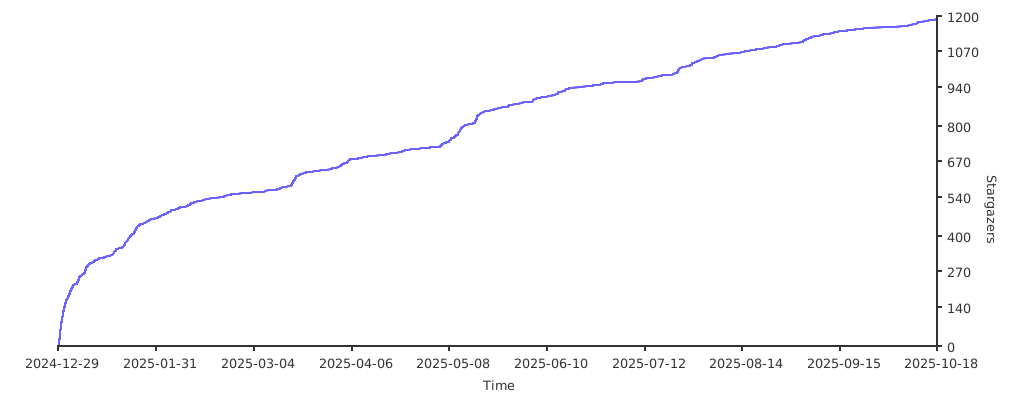
Stargazers 🌟
Security Advisory
- DEVELOPMENT USE ONLY: This platform is designed exclusively for testing environments. Production deployment presents significant security risks.
- ISOLATION REQUIRED: Execute only in isolated virtual machines or dedicated testing environments.
- WARRANTY DISCLAIMER: Provided without guarantees; use at your own risk.
- LEGAL COMPLIANCE: Users are responsible for ensuring all usage complies with applicable laws and regulations.
Acknowledgments
This project incorporates technologies from the following contributors:
Interface
