 BlackSnufkin
193a06d4c9
BlackSnufkin
193a06d4c9
- AnalysisManager: static analyzers run concurrently via a ThreadPoolExecutor;
  dynamic stays parallel for yara/pe_sieve/moneta/patriot, hsb runs solo
  after to keep its sleep-timing measurements clean. Per-tool start +
  finish + wall-time logged so progress is visible.
- /analyze/all redesign: stat tiles (stages / alerts / elapsed),
  phase-banded rows, color-coded state pills, agent-down preflight
  marks unreachable EDR profiles SKIPPED instead of burning the timeout,
  done banner only links to stages that actually produced data.
- file_info hero: buttons fully data-driven — Static / Dynamic /
  HolyGrail / per-EDR-profile only render if the corresponding saved
  JSON exists for the sample.
- analyze_edr no longer writes a JSON for pre-execution failures
  (agent_unreachable / busy / error). The error still surfaces in the
  HTTP response; the saved-view route stops rendering fake results.
- Logging: single root-level handler, compact formatter — HH:MM:SS,
  fixed-width colored level, dim module name with package prefixes
  stripped, werkzeug renamed to http and access lines reformatted to
  METHOD path → status. urllib3 / requests muted to WARNING.
LitterBox







Table of Contents
- Overview
- Documentation
- Analysis Capabilities
- Analysis Engines
- Integrated Tools
- API Reference
- Installation
- Configuration
- Client Libraries
- Contributing
- Security Advisory
- Acknowledgments
- Interface
Overview
LitterBox provides a controlled sandbox environment designed for security professionals to develop and test payloads. This platform allows red teams to:
- Test evasion techniques against modern detection techniques
- Validate detection signatures before field deployment
- Analyze malware behavior in an isolated environment
- Keep payloads in-house without exposing them to external security vendors
- Ensure payload functionality without triggering production security controls
The platform includes LLM-assisted analysis capabilities through the LitterBoxMCP server, offering advanced analytical insights using natural language processing technology.
Note: While designed primarily for red teams, LitterBox can be equally valuable for blue teams by shifting perspective – using the same tools in their malware analysis workflows.
Documentation
LitterBox Wiki - Advanced configuration and technical guides
Key sections:
- Scanner Configuration - HolyGrail, Blender, and FuzzyHash setup
- YARA Rules Management - Custom rules and organization
- Configuration Reference - Complete config.yml options
- Architecture & Development - System design and custom scanners
Analysis Capabilities
Initial Processing
| Feature | Description |
|---|---|
| File Identification | Multiple hashing algorithms (MD5, SHA256) |
| Entropy Analysis | Detection of encryption and obfuscation |
| Type Classification | Advanced MIME and file type analysis |
| Metadata Preservation | Original filename and timestamp tracking |
| Runtime detection | Compiled binary identification |
Executable Analysis
For Windows PE files (.exe, .dll, .sys):
- Architecture identification (PE32/PE32+)
- Compilation timestamp verification
- Subsystem classification
- Entry point analysis
- Section enumeration and characterization
- Import/export table mapping
- Runtime detection for Go and Rust binaries with specialized import analysis
Document Analysis
For Microsoft Office files:
- Macro detection and extraction
- VBA code security analysis
- Hidden content identification
- Obfuscation technique detection
LNK Analysis
For Windows shortcut Files (.lnk)
- Target execution paths and arguments
- Machine tracking identifiers
- Timestamps and file attributes
- Network share information
- Volume and drive details
- Environment variables and metadata
Analysis Engines
Static Analysis
- Industry-standard signature detection
- Binary entropy profiling
- String extraction and classification
- Pattern matching for known indicators
Dynamic Analysis
Available in dual operation modes:
- File Analysis: Focused on submitted samples
- Process Analysis: Targeting running processes by PID
Capabilities include:
- Runtime behavioral monitoring
- Memory region inspection and classification
- Process hollowing detection
- Code injection technique identification
- Sleep pattern analysis
- Windows telemetry collection via ETW
HolyGrail BYOVD Analysis
Find undetected legitimate drivers for BYOVD attacks:
- LOLDrivers Database: Cross-reference against known vulnerable drivers
- Windows Block Policy: Validation against Microsoft's recommended driver block rules for Windows 10/11
- Dangerous Import Analysis: Detection of privileged functions commonly exploited in BYOVD attacks
- BYOVD Score Calculation: Risk assessment based on exploitation potential and defensive controls
EDR Integration
Dispatch a payload to a separate, EDR-instrumented Windows VM and pull the correlated detection alerts back into the LitterBox results page. Two profile kinds are supported, both backed by the same Whiskers agent:
kind: elastic— LitterBox queries an operator-deployed Elastic stack for alerts raised against the run. Best for Elastic Defend or any other EDR whose alerts ship to Elasticsearch.kind: fibratus— LitterBox polls Whiskers's/api/alerts/fibratus/since, whichwevtutil-queries the EDR VM's Windows Application event log forProvider=Fibratusrecords. Best for the Fibratus open-source ETW detection engine — no remote backend required.
Built around three components:
- Whiskers — single-binary Rust agent (
Whiskers/) that runs on the EDR VM. Exposes lock acquire/release, multipart payload upload (XOR-on-the-wire), process spawn + kill, stdout/stderr/exit-code capture, agent self- identification (auto-discovered hostname + Fibratus presence), and the/api/alerts/fibratus/sinceevent-log query for Fibratus profiles. Single-occupancy by design; one run at a time per VM. - ElasticEdrAnalyzer — orchestrator for
kind: elasticprofiles. - FibratusEdrAnalyzer — orchestrator for
kind: fibratusprofiles. Same two-phase shape as Elastic but Phase 2 polls Whiskers's event-log endpoint instead of Elasticsearch, and normalizes Fibratus's native alert shape (events[].proc.{name,exe,cmdline,parent_name,…}+ baretactic.id/technique.idMITRE labels) into the saved-view renderer's dict.
Capabilities include:
- Two-phase orchestration — Phase 1 (lock + exec + log fetch on the agent) returns in ~1-7s; Phase 2 (alert correlation) polls in the background with early-return on first hit and an 8-second settle window for related-alert bursts. Lock is released after Phase 1 so back-to-back dispatches don't queue.
- Per-payload alert correlation — query is scoped by
host.name(case- insensitive) AND filename match acrossfile.name/process.name/file.path/process.executable/process.command_line/process.argsfor Elastic; the Fibratus path filters onevents[].proc.*substring match. - AV-block detection — Whiskers tags the run as
viruswhen Defend intercepts on file write or spawn; orchestrator surfaces the prevention alert as a distinctsummary.blocked_by_av: trueflag. - EDR-kill detection — when the agent didn't issue the kill but the process exited non-zero, the run is labeled "killed by EDR behavior protection". For DLL payloads (rundll32-spawned), the heuristic additionally requires alert evidence to avoid false positives from benign rundll32 exit codes.
- DLL execution —
.dllpayloads spawn viarundll32.exe <path>,<entry> [args…]; the entry point is the first token of the executable-args field (rundll32 syntax<ExportedFunction> [args…]). - XOR-on-the-wire — every dispatch picks a random byte 0-255, XORs the payload before multipart upload, and tells Whiskers to reverse the XOR while writing to disk. Avoids leaving cleartext in HTTP buffers / OS network stacks where Defender's network inspection would flag it pre-write.
- Rich alert detail — per-alert expandable panel with rule reason, rule
description, MITRE ATT&CK tactic/technique chips, triggering API + behaviors,
memory region + protection flags, full call stack with module provenance,
final user module callout, process tree (spawned + parent), Defend's response
actions (kill targets, tree kills), user identity, raw
_source. - Live agent dashboard —
/whiskerslists every registered profile with live agent + backend reachability;/shows the system dashboard with scanner availability + EDR fleet health. Both backed by an in-process TTL cache + background poller, so the dashboard loads instantly even when one VM is unreachable. - Saved-view route —
/results/edr/<profile>/<target>renders the run's saved findings using the same renderer as the live scan view (no fork).
The integration is profile-driven — drop one or more Config/edr_profiles/*.yml
files (gitignored; ship as *.example.yml) and each registered profile gets
its own button on the upload page. Deployment is operator-managed; LitterBox
does not deploy Elastic, Fibratus, or the EDR VM.
Doppelganger Analysis
Blender Module
Provides system-wide process comparison by:
- Collecting IOCs from active processes
- Comparing process characteristics with submitted payloads
- Identifying behavioral similarities
FuzzyHash Module
Delivers code similarity analysis through:
- Maintained database of known tools and malware
- ssdeep fuzzy hash comparison methodology
- Detailed similarity scoring and reporting
Integrated Tools
Static Analysis Suite
- YARA - Signature detection engine
- CheckPlz - AV detection testing framework
- Stringnalyzer - Advanced string analysis utility
- HolyGrail - BYOVD Hunter
Dynamic Analysis Suite
- YARA Memory - Runtime pattern detection
- PE-Sieve - In-memory malware detection
- Moneta - Memory region IOC analyzer
- Patriot - In-memory stealth technique detection
- RedEdr - ETW telemetry collection
- Hunt-Sleeping-Beacons - C2 beacon analyzer
- Hollows-Hunter - Process hollowing detection
EDR Integration Suite
- Whiskers (this repo,
Whiskers/) - Single-binary Rust HTTP agent for EDR-VM dispatch + Fibratus event-log query - Elastic Defend - EDR backend for
kind: elasticprofiles (operator-deployed via elastic-container-project) - Fibratus - Open-source ETW detection engine for
kind: fibratusprofiles (no remote backend)
API Reference
The URL convention puts the analysis type / qualifier BEFORE the target hash
everywhere — /results/<type>/<target>, /api/results/<type>/<target>,
/api/results/edr/<profile>/<target> — to match the existing
/analyze/edr/<profile>/<target> shape.
File Operations
POST   /upload                    # Upload samples for analysis
GET    /upload                    # Drop-zone page (analysis-mode picker)
GET    /files                     # Retrieve processed file list
Analysis Endpoints
GET    /analyze/static/<hash>             # Execute static analysis
POST   /analyze/dynamic/<hash>            # Perform dynamic file analysis
POST   /analyze/dynamic/<pid>             # Conduct process analysis
GET    /analyze/edr/<profile>/<target>    # Render EDR results page (uses analysis_type=edr)
POST   /analyze/edr/<profile>/<target>    # Dispatch payload to EDR profile (Phase 1 sync, Phase 2 background)
GET    /analyze/all/<target>              # "All" pipeline coordinator page (Static + every EDR profile in parallel; Dynamic waits only for Static)
HolyGrail BYOVD Analysis
POST   /holygrail                 # Upload driver for BYOVD analysis
GET    /holygrail?hash=<hash>     # Execute BYOVD analysis on uploaded driver
Doppelganger API
# Blender Module
GET    /doppelganger?type=blender               # Retrieve latest scan results
GET    /doppelganger?type=blender&hash=<hash>   # Compare process IOCs with payload
POST   /doppelganger                            # Execute system scan with {"type": "blender", "operation": "scan"}

# FuzzyHash Module
GET    /doppelganger?type=fuzzy                 # Retrieve fuzzy analysis statistics
GET    /doppelganger?type=fuzzy&hash=<hash>     # Execute fuzzy hash analysis
POST   /doppelganger                            # Generate database with {"type": "fuzzy", "operation": "create_db", "folder_path": "C:\path\to\folder"}
Results Retrieval (JSON)
GET    /api/results/info/<target>             # File metadata
GET    /api/results/static/<target>           # Static analysis results
GET    /api/results/dynamic/<target>          # Dynamic analysis (file or PID)
GET    /api/results/holygrail/<target>        # BYOVD analysis results
GET    /api/results/risk/<target>             # Computed Detection Score + triggering indicators
GET    /api/results/edr/<target>              # Index of every EDR profile run for this target
GET    /api/results/edr/<profile>/<target>    # Saved findings for a specific EDR profile (used by Phase-2 polling)
EDR + System Health
GET    /api/edr/profiles                                       # List registered EDR profiles (public — no secrets)
GET    /api/edr/agents/status                                  # Per-profile agent + backend reachability snapshot (TTL-cached)
GET    /api/edr/fibratus/<profile>/alerts/since?from=&until=   # Test/debug passthrough — query the Whiskers agent's Fibratus event-log endpoint without dispatching a payload
GET    /api/system/scanners                                    # Inventory of configured local analyzers + whether their binaries exist
HTML Report Generation
GET    /api/report/<target>                  # Generate comprehensive HTML report (target = hash or pid)
GET    /api/report/<target>?download=true    # Download report as file attachment
GET    /report/<target>                      # Download report directly (redirects to api with download=true)
Web Interface (Pages)
GET    /                                  # System dashboard — scanner availability + EDR agent reachability
GET    /upload                            # Upload drop-zone (analysis-mode picker)
GET    /whiskers                          # EDR agents inventory (live status per registered profile)
GET    /summary                           # Cross-file results summary
GET    /results/info/<target>             # File information page
GET    /results/static/<target>           # Static analysis report
GET    /results/dynamic/<target>          # Dynamic analysis report
GET    /results/holygrail/<target>        # BYOVD analysis results
GET    /results/edr/<profile>/<target>    # Saved EDR findings (rich detail — same renderer as the live scan)
System Management
GET    /health                   # System health verification
POST   /cleanup                  # Remove analysis artifacts
POST   /validate/<pid>           # Verify process accessibility
DELETE /file/<target>            # Remove specific analysis
Installation
Windows Installation
System Requirements:
- Windows operating system
- Python 3.11 or higher
- Administrator privileges
Deployment Process:
- Clone the repository:
git clone https://github.com/BlackSnufkin/LitterBox.git
cd LitterBox
- Configure environment:
python -m venv venv
.\venv\Scripts\Activate.ps1
pip install -r requirements.txt
Operation:
# Standard operation
python litterbox.py

# Diagnostic mode
python litterbox.py --debug
Access:
- Web UI:
http://127.0.0.1:1337 - API Access: Python client integration
- LLM Integration: MCP server
Linux Installation
System Requirements:
- Linux operating system
- Docker and Docker Compose
- Hardware virtualization support
Deployment Process:
- Clone the repository:
git clone https://github.com/BlackSnufkin/LitterBox.git
cd LitterBox/Docker
- Run automated setup:
chmod +x setup.sh
./setup.sh
Note
: Initial setup takes approximately
1 hourdepending on internet speed and system resources.
The setup script automatically:
- Installs Docker, Docker Compose, and CPU checker
- Verifies KVM hardware virtualization support
- Creates Windows 10 container environment with automated LitterBox installation
- Starts containerized Windows instance
Access:
- Installation monitor:
http://localhost:8006(track Windows setup progress) - RDP access:
localhost:3389(available after installation completes, creds in docker file)
Once installation completes, LitterBox provides:
- Web UI:
http://127.0.0.1:1337 - API Access: Python client integration
- LLM Integration: MCP server
For API access, see the Client Libraries section.
Configuration
All settings are stored in config/config.yml. Edit this file to:
- Change server settings (host/port)
- Set allowed file types
- Configure analysis tools
- Adjust timeouts
EDR Setup (optional)
EDR integration is opt-in — drop one or more profile YAMLs under
Config/edr_profiles/ and the upload page picks them up at boot. Two profile
kinds are supported with distinct setup paths.
Common: deploy Whiskers on the EDR VM
Whiskers.exe is a single-binary Rust agent (~1.6 MB, no runtime deps). See
Whiskers/README.md for the full guide. Quick version:
# on the EDR VM
mkdir C:\Tools -Force
# copy Whiskers.exe into C:\Tools\

New-NetFirewallRule -DisplayName "Whiskers Agent" -Direction Inbound `
    -Protocol TCP -LocalPort 8080 -Action Allow

# Register as an at-logon scheduled task so it auto-starts.
# Runs as the invoking user (no UAC); payloads inherit that privilege.
C:\Tools\Whiskers.exe --install
# Log out / back in to trigger the scheduled task, OR run it manually:
C:\Tools\Whiskers.exe
Payloads land in <exe_dir>\samples\ by default. Override per-VM with
--samples-dir <path> or per-dispatch via the profile YAML's drop_path.
If you're using Elastic Defend, add Whiskers.exe as a Trusted Application
in Defend's policy (Kibana → Security → Manage → Trusted Applications), since
the agent spawns arbitrary payloads.
Option A: kind: elastic (Elastic Defend)
1. Stand up an Elastic stack — LitterBox does not deploy or manage one. The fastest path is elastic-container-project which gives you Elasticsearch + Kibana + Fleet locally. Once it's up:
- Enable the Elastic Defend integration on a Fleet policy
- Enroll your EDR Windows VM into that policy
- Optionally enable Detection-Engine rules in Kibana → Security → Manage → Rules
- Create an API key under Stack Management → API keys with read access to
.alerts-security.alerts-*,.internal.alerts-security.alerts-*, and.ds-logs-endpoint.alerts-*. Copy the encoded value.
2. Configure the profile — copy
Config/edr_profiles/elastic.yml.example to elastic.yml (the real file is
gitignored) and fill in:
name: "elastic"
display_name: "Elastic Defend"
kind: "elastic"                        # default; can be omitted for back-compat
agent_url: "http://<edr-vm-ip>:8080"
elastic_url: "https://<elastic-stack-ip>:9200"
elastic_apikey: "<base64-encoded-key>"
elastic_verify_tls: false              # self-signed cert from elastic-container-project
wait_seconds_for_alerts: 90            # max poll window for successful execs
av_block_wait_seconds: 60              # max poll window for AV-block events
exec_timeout_seconds: 60               # how long to let the payload run
Option B: kind: fibratus (Fibratus open-source ETW)
No Elastic stack needed — Fibratus does ETW collection + rule matching locally on the EDR VM and writes alerts to the Windows Application event log. Whiskers queries the log on demand.
1. Install Fibratus on the EDR VM from
github.com/rabbitstack/fibratus.
Default install path is C:\Program Files\Fibratus\; Whiskers detects this
and reports telemetry_sources: ["fibratus"] via /api/info.
2. Configure Fibratus to write JSON alerts to the event log. Edit
%PROGRAMFILES%\Fibratus\Config\fibratus.yml:
alertsenders:
  eventlog:
    enabled: true
    format: json    # CRITICAL — analyzer parses the <Data> field as JSON
Make sure filters.rules.enabled: true and filters.rules.from-paths points
at the rule pack you want active. Restart the service:
net stop fibratus; net start fibratus.
3. Configure the profile — copy
Config/edr_profiles/fibratus.yml.example to fibratus.yml and fill in:
name: "fibratus"
display_name: "Fibratus"
kind: "fibratus"
agent_url: "http://<edr-vm-ip>:8080"
wait_seconds_for_alerts: 30            # Fibratus pushes in real-time → shorter
av_block_wait_seconds: 30
exec_timeout_seconds: 60
Verifying the wire
hostname is not configured — the agent self-reports it via
GET /api/info, so moving the agent to a different VM is transparent. Restart
LitterBox after editing any profile YAML; the upload page gains a button per
registered profile.
Quick smoke-tests with the GrumpyCats CLI:
python GrumpyCats/grumpycat.py edr-profiles                                # list registered profiles
python GrumpyCats/grumpycat.py edr-status                                  # live agent + backend probe
python GrumpyCats/grumpycat.py fibratus-alerts --profile fibratus \
    --from 2026-04-30T00:00:00Z                                            # pull alerts via Whiskers without running a payload
Client Libraries
For programmatic access to LitterBox, use the GrumpyCats package:
The package includes:
-
grumpycat.py: Dual-purpose tool that functions as:
- Standalone CLI utility for direct server interaction
- Python library for integrating LitterBox capabilities into custom tools
-
LitterBoxMCP.py: Specialized server component that:
- Wraps the GrumpyCat library functionality
- Enables LLM agents to interact with the LitterBox analysis platform
- Provides natural language interfaces to malware analysis workflows
Contributing
Development contributions should be conducted in feature branches on personal forks. For detailed contribution guidelines, refer to: CONTRIBUTING.md
Support 🍺
If LitterBox has been useful for your security research:

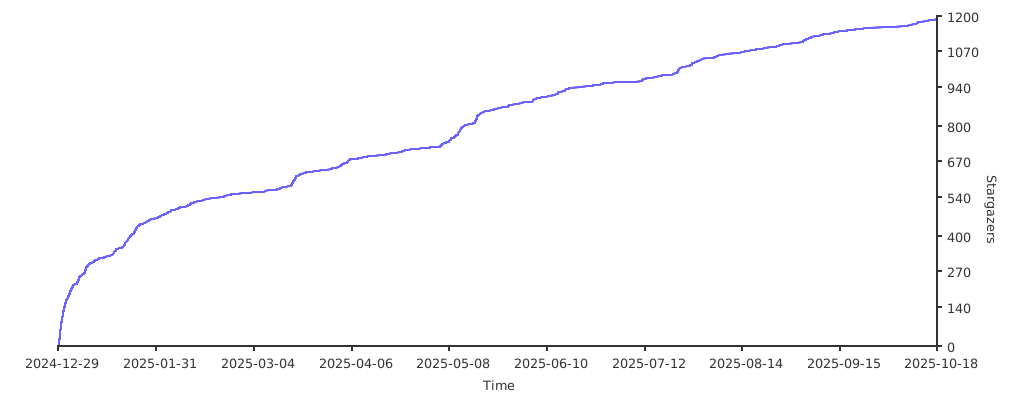
Stargazers 🌟
Security Advisory
- DEVELOPMENT USE ONLY: This platform is designed exclusively for testing environments. Production deployment presents significant security risks.
- ISOLATION REQUIRED: Execute only in isolated virtual machines or dedicated testing environments.
- WARRANTY DISCLAIMER: Provided without guarantees; use at your own risk.
- LEGAL COMPLIANCE: Users are responsible for ensuring all usage complies with applicable laws and regulations.
Acknowledgments
This project incorporates technologies from the following contributors:
Interface
